
EN
- INDUSTRIES
- PRODUCTS
- PLATFORMS
- EMS
- Company
- Career
Ravensburger Str. 128–134
88276 Berg/Ravensburg
Germany
P +49 751 89-0
F +49 751 89-1300


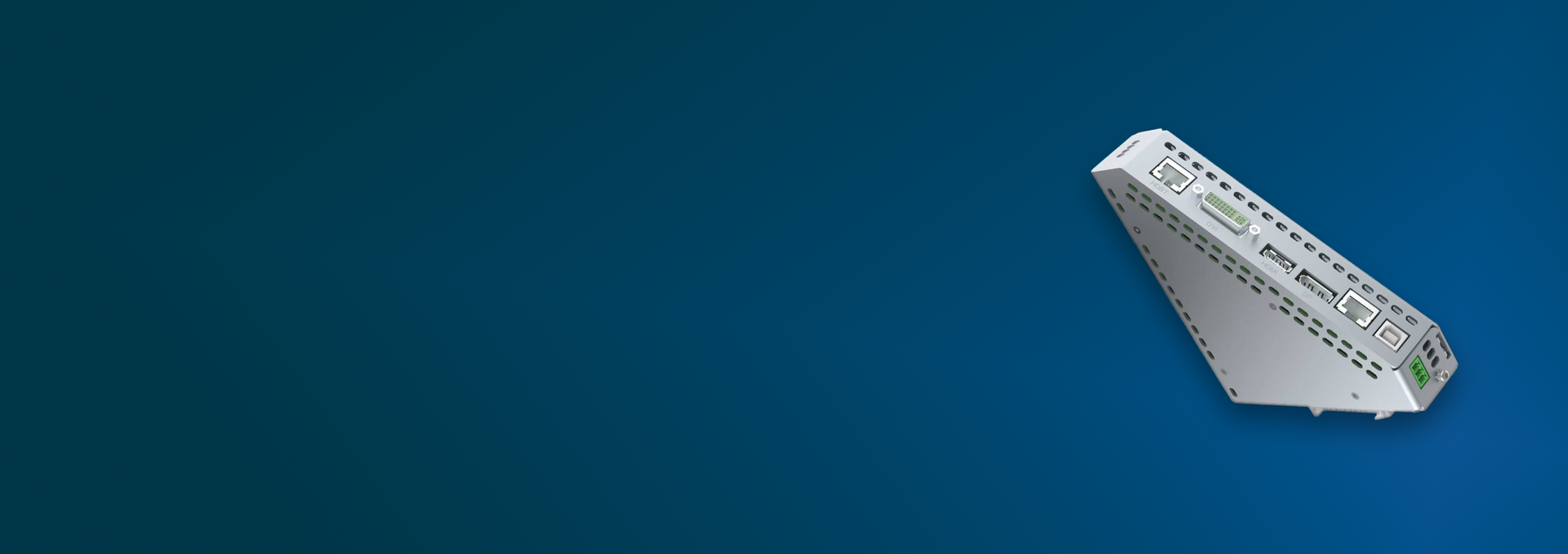
EXTENDED DISPLAY LINK. A new gateway technology that enables touch-based HMI panels to be connected to remote application controllers. This technology is particularly relevant for manufacturers of machining centers, mobile machines, and commercial vehicles that equip their products with high-performance central control units in order to minimize the use of additional decentralized computing units. By outsourcing HMI display control to the central CPU, slimmer operating panels without dedicated control units and cooling systems can be used.
However, larger distances between HMI panels and the application CPU can lead to transmission problems, as standard interfaces only support distances of up to 10 meters. For this reason, we developed the EXTENDED DISPLAY LINK gateway platform, which enables lossless, real-time transmission of video and audio signals, user inputs, USB data, and internet and network protocols over distances of up to 100 meters.
EXTENDED DISPLAY LINK solutions consist of a gateway module installed in the application controller and a matched counterpart integrated directly into the GLASSCAPE touch displays. Depending on the distances to be bridged and the required bandwidth, three performance classes are available: Short Range, Mid Range, and Full Range. The gateways support various interfaces such as HDMI, DisplayPort, USB, and Ethernet to transmit video, audio, control, and communication signals.
The EDL Full Range gateway is available as a remote HDBaseT standard module and enables transmission over distances of up to 100 meters. It features interfaces such as HDMI, DisplayPort, DVI, USB, and Ethernet, and supports data rates of up to 8 Gbit/s. The gateway can supply power to the HMI panel via a common CAT5e cable and also supports the BroadR-Reach protocol for onboard vehicle systems.
EXTENDED DISPLAY LINK technology enables machine and plant manufacturers to standardize their HMIs and choose a slim design. This leads to cost savings through the elimination of CPUs and the use of standard cables, as well as a reduction in development, maintenance, and software effort.


