Contact
Contact
RAFI GmbH & Co. KG

Ravensburger Str. 128–134
88276 Berg/Ravensburg
Germany
P +49 751 89-0
F +49 751 89-1300

Phone Link

SAFETY TOUCH & SAFETY DISPLAY

A NEW DIMENSION OF SAFETY
  1. Home
  2. Ι PLATFORMS
  3. Ι TOUCH SOLUTIONS

Touchscreens have fundamentally changed the way machines are operated. Flexible user interfaces, intuitive user guidance, and the ability to display functions, input fields, and status indications in a variety of ways make it the preferred input technology in modern HMI systems. 

However, as soon as safety-related machine functions are controlled via the touchscreen, the requirements increase significantly – both for input and for display. RAFI addresses both of these aspects with two complementary technology platforms: SAFETY TOUCH® and SAFETY DISPLAY.

SAFETY TOUCH®: SAFETY-RELATED TOUCH INPUT

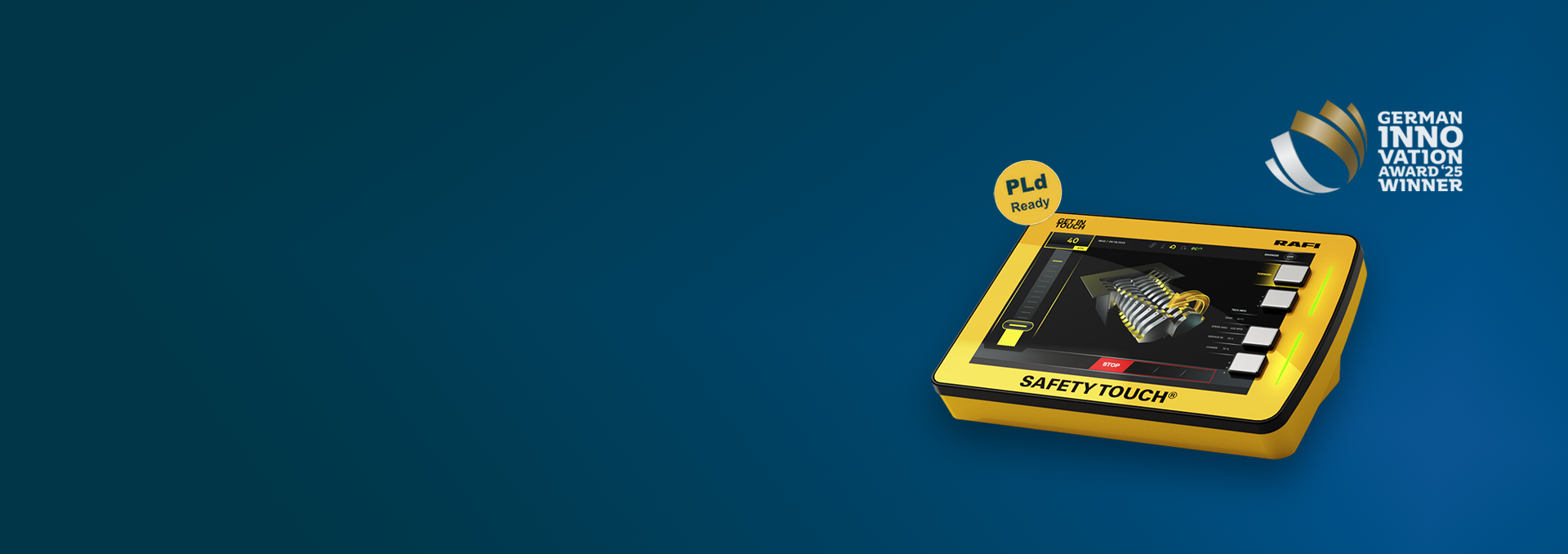
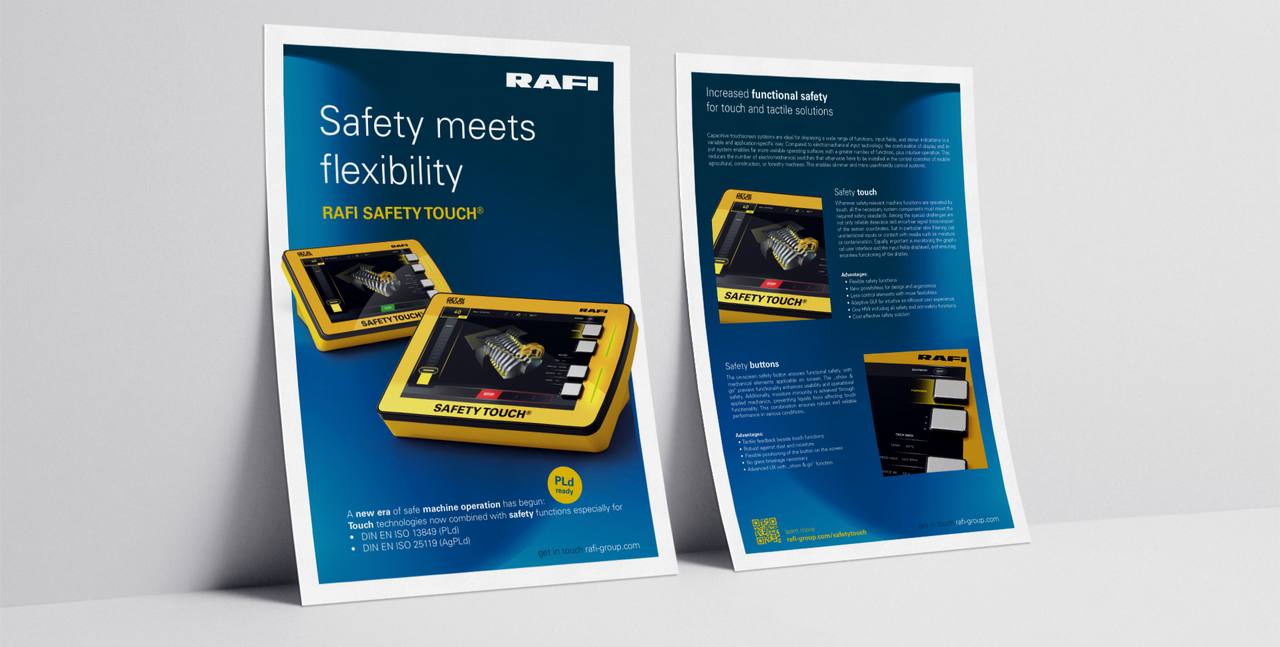
SAFETY Touch® is a technology platform for series production of touch systems. It was specifically developed for SAFETY-critical applications and can achieve Performance Level d (PL d) in accordance with DIN EN ISO 13849 and ISO 25119. The concept is based on the following pillars:

  • Reliable hardware and redundant architecture: Durable hardware components and a redundant sensor architecture are used to ensure reliability.
     
  • Comprehensive diagnostic software: Sophisticated diagnostic software provides software-based protection for the system and offers greater flexibility than hard-wired safety features.
     
  • Dedicated safety controller: In addition to the touch controller, a dedicated safety controller with its own logic has been implemented to monitor all safety-related factors. This includes the touch sensors, the display, the validation of command inputs and outputs, and the cyclic functional tests performed every millisecond.
     
  • Protection against unintended inputs: Configurable filter functions suppress sensor signals that could be triggered by accidental contact, liquids, or other unintended effects.
     
  • Continuous display monitoring: The system ensures that the user interface is displayed correctly. Optional force detection can be used as an additional safeguard against incorrect entries.
     
  • Integration of safety buttons: Functional-safety-certified electromechanical actuators can be mounted directly on the touch surface to further enhance functional safety.

SAFETY DISPLAY: RELIABLE DISPLAY IS MANDATORY

Accurate input alone is not enough; it must be accompanied by a reliable display. After all, operators can make informed and sound decisions only when they can see the right information in the right place on the display. 

  • Continuous monitoring: Since the computing units are generally Linux-based and therefore not inherently security-focused, there has been a critical monitoring gap throughout the entire signal chain. RAFI closes this gap with an optical watchdog that continuously monitors the entire transmission path – from the CPU processor to the operating system and graphics framework to the display.
     
  • The system checks three key aspects: the display’s input current (power monitoring), the optical performance of the LCD and backlight (optical display monitoring), and the integrity of the displayed content (display content integrity check). This ensures that the display operates without errors and that the correct content is actually displayed in the right place, even if the underlying software layer is not safety-critical.
     
  • Seamless monitoring of the entire display chain: The patented watchdog monitors the entire path from the CPU to the display, regardless of whether the CPU and operating system are security-oriented or not. This marks the first time that software has been included in the safety considerations.
     
  • Fewer operating elements, greater clarity: By combining an adaptive user interface with safety-oriented input, the number of physical switches and key switches can be significantly reduced – resulting in leaner, more ergonomic control systems.
site-to-top